There’s something about having the trailer that makes the film feel that last bit of really-for-realz to me. I’m so pleased and proud.
Isn’t it cool?
There is a story to tell around this: there have been bogus OtherLife trailers bobbing about on YouTube for months, garnering hundreds of thousands of views. For the most part, these so-called trailers were badly edited, narratively random, and intended only to pull hits and lure people to torrented versions of various pirated films. Seriously, I have never seen a worse “movie trailer” in my life than the mess I saw back in the fall carrying the title “official OtherLife Netflix trailer.” The majority of comments left by well-intentioned viewers who thought they were seeing a real trailer were some version of This is stoopid, I would never watch this film! It made me fucking nuts.
Well, here is the official trailer at last and it is not stoopid. It is smart and beautiful, and I’m delighted to have it.
Nicola and I traveled to San Diego this weekend for the North American premiere of OtherLife at the San Diego Film Festival, to see the film screened at a real live theatre with a real live audience.
So here is the magic: the house lights go down and people fall silent, and there are promotional trailers. And then the film begins. The size of it takes my breath away – the lushness of the visual experience, the details that rebalance themselves on the bigger screen, the nuances of sound through the cinema system. At this larger scale, the film feels even more intimate to me (and it’s very close POV to begin with): I can see every actor’s expression and physical behavior so clearly, and the larger landscape makes the subtleties even more subtle.
And holy wow, it is so fucking beautiful.
This is the culmination of a very long journey for me. Every writer hopes to see a novel adapted in a way that makes her proud of the book; every screenwriter hopes for a produced film that makes her proud of the script. It doesn’t happen that often: a lot of moving pieces have to align for a film to come together, perhaps especially so when it’s an indie production like ours. I feel extraordinarily fortunate that it has happened for me, and that I could see the film as it was made to be seen: at scale, intimacy writ large, in the company of others.
The theatre and film festival staff were fabulously helpful. I’m so grateful to the friends who came to support me, and to all the film lovers who showed up because they were interested. Everyone was attentive and absorbed, and had great questions and comments during the Q&A. I felt for the first time like a member of an active film community, not just a member of my movie team. It’s a great feeling.
Many thanks to SDIFF for hosting the film and giving me this chance to see it. It was an amazing evening for me.
I’ve spent a lot of time over the years shopping for film and television writing coaching. I’ve taken workshops, I’ve had professional coverage, I’ve read a hundred books and countless blogs.
Of all those possible learning resources, the only one I’ve ever recommended is the workshop series offered by Corey Mandell and Talton Wingate. Corey and Talton will again be offering the first workshop in the series, Professional Screenwriting and Television Writing, in September. It’s an 8-week class with live remote 3-hour workshops held once a week. Full-on lectures in Week 1 and Week 8: lecture, new concepts, writing exercises, and individual feedback on homework the other 6 weeks.
Go take it. Then take the Conceptual Intensive, which is a non-required class that you can take between the first workshop and the advanced class (which I just completed and absolutely loved). The CI is the single hardest class I’ve ever taken as an adult, a firewalk with a mountain of homework and a sense of push-to-grow that reminded me of my Clarion experience, or the 41 stories I wrote in 41 days on behalf of Clarion West a few years ago.
(To illustrate this: I got laid off from my 2-year contract job along with 28% of the rest of the company last summer during the final week of the Conceptual Intensive. My first response was Oh, shit. My second response was Well, I’ll have time to do my homework now. And I did. It was totally worth it. That class scared the bejesus out of me, and I loved it.)
As you move through the workshop series, you’ll get to work with Corey, Talton, and their colleague Lauren “Tough Love” Ludwig (no, I don’t think that’s the middle name her parents gave her, but it should be). All of these people are smart, funny, expert, generous with their coaching, and every single one of them will learn your little ways as a writer and tell you to carry on, or to stop that shit.
I think it helps to have some writing (prose or screenwriting) experience going into these workshops, but it’s not essential. From my perspective, the people who have the toughest time are those who want to argue that the concepts being taught, or the feedback on their work, are completely wrong. I have seen a couple of people get very mulish in a way that I see in emerging prose writers as well: If you really understood what I’m doing you would totally see how perfect it is! Pro tip: don’t be that person, ever. It gets you nowhere.
If you want to learn more about screenwriting, have the will to grow and aren’t afraid of being truly workshopped – of hanging your ass out for everyone to see so that you can learn – then go check out the website and the class. Bring your growth mindset and your absolute willingness to embrace feedback, work your ass off, provide support to your workshop cohort, and get over the need to be perfect. Because the need to be perfect is the enemy of growth.
And if you decide to go for it, do let me know. I’d love to hear about your experience.
I’m just as real as everyone else! (image from about a million Pinterest sites)
(Hey, guess what? You can now find The OtherLife Journals on Medium!)
One of the biggest mistakes I made as a brand-new screenwriter with a real project at stake was that I was afraid to ask questions about my craft and my role. What did Real Movie People expect from a professional writer? I had no idea. I knew it was my job to write the script, but that’s like knowing your job is to wash the car. What do real car-washers do? Where do they start? What are the best tools? What are the most important parts to get right? Where’s the gruff-but-kindly gum-chewing grey-haired woman in greasy overalls who gives me a bucket and tells me Kid, make sure you close the windows tight, don’t use a stiff brush, and remember who owns the car?
I got instructions on proper screenplay formatting from books. I found lots of internet posts about the importance of pithy, active, visual storytelling, which were inspiring but not by themselves terribly useful. What I badly needed was specific writing advice on structuring screen stories, sequences and scenes driven by clear externalized goals.
→ Hard-won pro tip #1 to character-driven-novelists-turning-screenwriters: Feelings are not plot. You need both. I’m sorry. You actually need both in novels too, but you can get away with, for example, a single plot event engendering a whole chapter of feelz. This prose strategy, like so many, is not directly transferrable to scripts, and will not create a selling screenplay for you. Ask me how I know. ←
I also badly needed specific working-writer advice on attitude and approach. Who gets to decide what the story is? As the writer, was I supposed to fiercely defend the movie in my head against all challenges? Or was I supposed to change things up every time someone said boo? Were some people’s notes more important than others? If people didn’t understand the story, or didn’t like it, or wanted to change it, did that mean I was a bad writer? Wouldn’t everyone love it if it were good enough?
I needed to learn everything. But I was afraid to slow down and ask anyone. So I dove in and learned by doing, as I have done with most everything in my life. This is a great skill to have when you need it, when you have to make a wild-ass leap and take your best shot before you are ready. It is a bullshit way to become a professional.
I flailed my way into a place where people began responding to parts of the script with enthusiasm, and I didn’t feel so panicked all the time. What I should have done right then, the very first non-panicked minute, was find the best screenwriting workshop I could (I highly recommend this one), read the hundreds of scripts I should already have read by that point, hunt down writing analysis of scripts online, and et cetera. But I didn’t. Instead I started figuring out by myself what parts of my script people were liking, and how to apply those same principles to the parts that they didn’t.
As I continued to write version after version of OtherLife, I did learn some good craft from notes, from conversations, from blog posts, from sheer stubbornness. Unfortunately, I also learned a bunch of bad craft from those same sources. Most people who gave me specific notes were not working writers themselves, and didn’t know jack shit about how to fix what was troubling them. That didn’t stop them from giving me specific writing instructions, which I did my best to execute because they were producers and managers and agents: they knew what successful films looked like, and I assumed, hoped, clung to the belief that this meant they knew what worked in scripts.
Well, sometimes they did, and sometimes they didn’t. Sometimes they were simply chasing money: a distributor was looking for a film that did x, and if we did x with our film they would read it. So off I went and did x to the best of my ability, often without the right tools. I wrote a lot of perfectly mediocre scenes — good story ideas uninterestingly executed, or over-explained, or too tightly packed because my developmental producer recoiled at anything that smacked to him of exposition.
→ Hard-won pro tip #2: Explaining is necessary in movies. We need context. We can’t read the minds of characters on screen like we can in novels. And showing — action without words — is important but not usually emotionally sufficient. At some point someone has to explain themselves, or the situation, or the other person, plainly enough that we get it. This is exposition. The skill is in doing it so that it becomes integral to the film moment we are in: the “visitor’s hall/science exhibit” of Jurassic Park is brilliant exposition, pure infodump wrapped in the skin of a theme park thrill ride. Context revealed through conflict — another excellent strategy for exposition, for great examples see every episode of Firefly — is something I understood intuitively early on, but had no vocabulary or conscious tools for. Understanding is good, but having conscious tools and knowing when to use them is what makes you a pro. ←
Other times, when told to do x, I had to stand my my ground and explain that x would completely derail the film because of the changes we would need in the rest of the script to support x if they wanted x make any fucking sense to the audience. Have you seen those movies where things just suddenly…happen? Those Wait, what? moments — that’s someone’s x, right there.
→ Hard-won pro tip #3: Even small changes to plot and character ripple forward and backwards through the script. This is just the same as short stories and novels, so stick to your guns and be super-specific about what Big Thing will break if this little thing is wodged into the script to make the distributor happy. Because when that Big Thing doesn’t make sense on the screen, no one will blame the distributor. They may not blame you either, but if you didn’t fight for it you will blame yourself. If they insist on the wodging, then do your best to handle the ripples, no matter how inclined you are to let them hang themselves with their own stupid choice. Because it’s your script until they take it away from you; and when they do, don’t you want it to be as strong as it can be even with its fractures? Because that’s your job. ←
Sometimes the people giving notes were absolutely right about the problem, but didn’t offer solutions. They were respecting my role as the writer: they expected me to go away and fix it. That was scary. I could handle trying to implement someone else’s ideas, and I could handle sticking to my guns when I knew an idea was fundamentally broken. But I didn’t know how to do pro-level diagnosis and identify the best solutions, because I hadn’t learned enough and I wouldn’t stop to get that help. Instead I went back to flailing. Sometimes I stumbled onto the right path, and I’m pretty proud overall of the script that made the Australian producers and director want to take on the film. But I could have gotten there much faster.
What was I so afraid of? Well, the surface-level fear was that I had to appear totally professional or I would be replaced. This fear is not unfounded: professionalism is a real thing, especially in a process-oriented creative industry. People making production decisions want a team they believe will do the job without babysitting or personal drama. This belief is based on some combination of credits, reputation, and previous working relationship. That’s one reason it’s such a hard business to break into (for anyone in any creative and/or technical role), and why I was afraid of shooting myself in the foot.
I spent two years terrified on a regular basis of being fired from the project. I didn’t realize until much later that the producers weren’t likely to hire a more professional writer unless another studio, mini-major, or distributor with deep pockets came along, because there would be no more development money until then. Even so, they had the right to replace me: and I knew that anyone bankrolling the film would replace me as part of the deal unless I could be That Perfect. So I continued to wrestle through on my own, with all the big mistakes and stress that any reasonable person except me would have seen coming like a mile-high train down five miles of straight track. Every time I got critical feedback about all the things that were wrong, I felt sad and angry and afraid, and sometimes I made dumb writing choices out of those feelings. Every time I got positive feedback about how someone loved the script, it reinforced my belief that my approach was the the right one: look, I was a better writer! Until the next round of criticism or rejection.
And I didn’t understand that all I had to do was to learn from others. It astonishes me now. I’m good at learning, and I’m good at helping other people learn. It’s one of my great strengths, and for years I turned it inside out and made it into a great weakness. I bought into the idea that in order to survive, I had to “just know” what I was doing. I believed that “acting as if” would magically transmute into “being real” someday. I believed that if I couldn’t do it all by myself, I wasn’t really a writer. And so I couldn’t be vulnerable: not to OtherLife people, not to other writers, not to anyone.
I cannot overstate how abysmally stupid this is. And I have lately come to understand that I have done it before, and that it has been the single biggest slowdown to my learning and growth as a writer and as a human being.
→ Hard-won pro tip #4: Do not make this choice. ←
I know where a lot of this “need to do it myself” comes from. I don’t think the underlying psychology is special or particular to me. I do think it’s frighteningly counterproductive. It is based in fear, and fear does not help us grow and improve as humans or writers or anything else. Ever. There are better ways to learn, in which we must be brave enough to reach out to others for help; to make mistakes; to practice until we get it right, however long it takes; to deal with how fucking long it takes sometimes; to keep going. We have to do our own work: but we do not need to be driven by fear off the nearest cliff just to prove that we can fly all by ourselves — or to prove that at least we know how to take a landing.
So I’m learning.
The OtherLife Journals are a series of chronologically-random posts about writing, selling, and making the film OTHERLIFE. One woman’s view of the wild ride of indie filmmaking. Find them on this blog or on Medium.
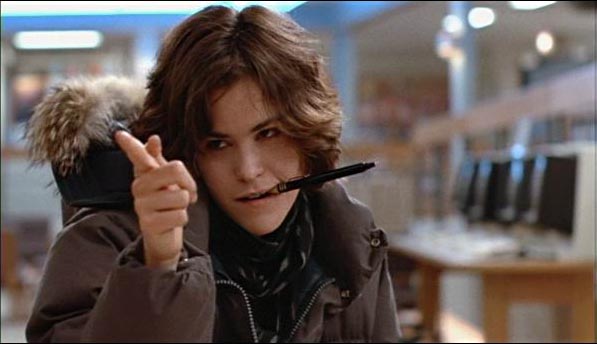
Aha, you’re fucking with me now, aren’t you? (image from The Breakfast Club)
Think of development hell as an infinite spin cycle. You are going to the Best Party Ever as soon as your laundry is done. Your amazingly cool shirt is too damp to wear but if you can just wait another 15 minutes… Oh good, it’s dry! But the wash cycle has left a spot on it, so you have to run it through again. It only takes 45 minutes: there’s still plenty of time to get to the party. Then the cat hoiks up a bile-yellow hairball on your jeans. That’s okay, you have another pair! Then your shoe breaks. But your hobby is cobbling (I think I said a really true thing about the entire indie film industry right there). You fix your shoe with a leather needle you had squirreled away in your junk drawer. You feel triumphant because you knew that needle would come in handy someday, no matter that it pokes you in the finger and makes you bleed all over your shoes.
And you dress and you’re sweaty and hopeful and excited, and you arrive at the Best Party Ever — and no one else is there. They all met another script that is throwing an Even Better Party than yours. You are not invited.
This happened for about eight years with OTHERLIFE.
—–
My experience of indie development hell is:
Hell is other people’s checkbooks.
Hell is other people’s schedules.
Hell is other people’s need to attach themselves to 57,000 projects, thereby ensuring from their perspective that they will not miss whatever turns out to be the best party. This means you get two seconds of their attention per year, but because they are attached, you have to run things by them. Bonus points when they promise to read the script this weekend and get back to you on Monday, which ensures that you are too anxious on Monday to get any meaningful work done. About a year later you realize that “Monday” means “no.”
Hell is other people’s belief that female-driven films don’t interest men and therefore will not make any money. Apparently women do not go to the movies or have any desire to see realistic, complex women characters in films. Apparently all men who go to the movies are 15 years old, straight, and interested only in breasts and blowjobs. And if any grownup men did go to the movies, they would want to see movies about themselves because men are more interesting than women. Don’t believe it? When’s the last time you saw an interesting movie about a woman? The people who tell you these things are some of the same people who complain with no apparent irony that there are no interesting movies being made anymore.
Hell is other people’s egos.
Hell is your ego.
Hell is your belief that you will never write a film that will interest anyone because you are an unproven untrained middle-aged woman who wants to write about women, and we know how well that usually turns out.
Hell is your disbelief that you have to justify the reality of your women characters to so many producers, managers, executives and readers. When you get notes about the character not being likable because she raises her voice to a man, you have a vertiginous moment of feeling like you in are in a movie yourself.
Hell is your lack of experience which makes it very hard to separate good notes from bad ones. When you try to hide this lack of experience by treating all notes as equally important, your script becomes what is technically known as a giant spaghetti mess. You are the writer. This is your fault. In all seriousness, it is.
The hard part of development hell is knowing that if I were a better writer, my script would make people put aside their other 56,999 projects, stop tweaking, dive in and get this fucker made. But development hell happens a lot in indie productions because the script is almost there, has a good concept or a compelling character, and with a little work…It’s almost dry. It just needs a little spin.
There are plenty of reasons movies go off the development rails. OTHERLIFE was set up at a major studio and then put into turnaround, meaning that the studio decided so firmly not to make the film that they wrote off the costs and sent the script home from the party. Turnaround is bad because it sends a signal that the script may not be strong enough to engender confident financing: even if the script is not the real problem, the signal of unconfidence is still a real signal.
Also, if someone else wants to make the script, they now have to take on those sunk development costs. In spite of this, OTHERLIFE was nearly financed multiple times by multiple people with big checkbooks who would have signed off on all those zeros if only we could get (insert Big Famous Name) to direct or star. We showed the script to a lot of those Big Names. We had a lot of conversations about notes, about improvements, about tweaking this or that element of the script to make it better.
Development hell happens because people have faith in your script. It happens because people commit and work hard and keep trying. It happens because an amazing director (I’ve had four) with one or two films under their belt sees your film as a great opportunity to actually get something interesting made… with a little work. It happens because a producer (the count of OTHERLIFE producers is in the double digits) who wants to make great films finds something in yours that they think could be worth investing months or years of their lives in trying to realize. We had a couple of people who were just slipstreaming on the script, attaching themselves because someone at a party mentioned it and they thought they might be missing out on an opportunity (this is a true story). Those people directly contributed to slowdowns in development. Development demons, if you will. But most of the people who have crossed paths with OTHERLIFE have been good, smart, creative, passionate folks who want to make movies because it’s hard and meaningful and fun. Those people are goddesses and gods to me, every single one of them who ever touched this script or believed in the project.
We were close-but-no-cigar so many times, and some of those people who believed in the script stopped believing, and moved on. Sometimes that was my fault: I was the writer who couldn’t make the script better. That’s a special hell.
But I’m learning (more about which soon). That’s part of what these journals are for: to figure out what I’ve learned, to get better, and to share those lessons so that maybe other writers can benefit. Today I will say that development hell brings its own set of lessons. One of the biggest is that as a writer, so much of development is outside your zone of control — those schedules, those egos, those dollars. So the part that’s in your control — the writing — had better be fucking perfect. No excuses. No matter what. Sometimes all you can be in charge of is whether you suck it up and do it again and learn. So be the great big boss of that.
The OtherLife Journals (OLJ) are a series of chronologically-random posts about writing, selling, and making the film OTHERLIFE. One woman’s view of the wild ride of indie filmmaking.
I knew that SOLITAIRE-the-script would be different from the book, although during the first year that the script was in development, I (predictably) indulged in the fantasy that the differences would be superficial. I wanted Ko. I wanted Solitaire-the-club. I wanted Jackal and Snow and Estar and Crichton and Scully and Razorboy and pink-haired Drake. Just writing their names here evokes them for me; all these years later, they are so real to me. But none of them were in the draft of SOLITAIRE that I read, or in the OTHERLIFE that you’ll see on screen. I’m truly good with that. They live in my heart and head (and also, I hope, in some of yours). And it turns out film scripts are difficult enough without putting them under the impossible burden of an un-filmable story.
If I had known how hard screenwriting is, I’m not sure I would have given Tommaso such a strong pitch to let me do the rewrite. And yet, one of the patterns of my life has been that sometimes the universe opens an unexpected door and invites me to walk through. I get to choose, but it’s a real choice: no door stays open forever, and they all lead to places of change that are not predictable in outcome. Those doors have led to my greatest joys, and my greatest failures, and my greatest tests. They have been the making of me.
I think this happens to a lot of people. I think most lives are tales of what happened when we were expecting other things. It’s not the door itself that is the story: it’s whether we walk through, and what we find. I don’t know about you, but often my initial thoughts are Oh wow this is going to be so cool WAIT WAIT SHIT what’s that over there? OMG that thing I’ve been so scared of for so long? That thing is what I just signed up for. I am SO FUCKED. It’s like walking out your front door and dropping into the Mariana Trench. Time to swim like hell.
I’m a good prose writer. My particular skills are in character, relationship, psychological nuance, the big impact of small choices. I can parse those things and write them down in 1,000 or 25,000 or 100,000 words. I basically swim in character soup when I’m writing. And characters are the heart of a good script: but making their stories come alive demands a different kind of writing excellence. I didn’t know this when I started the rewrite. I didn’t know how to construct a screen story. I didn’t know how to build visual narrative grammar. I didn’t yet know that Act 2 would long be a vast desert of Okay, Now What? I wasn’t just ignorant: I had the special self-assured ignorance of the expert who thinks that her tools will fit any situation.
The self-assurance lasted one day and one page into the rewrite. The second morning, I got up at 4 AM, made tea, put on my headphones, stared in blind panic at the terrible awfulness of the previous day’s work, and started swimming like hell. I worked every day for six weeks from 4AM to 6PM, stopping only when Nicola made highly unreasonable demands on my time and energy (you know, things like We should eat lunch now.) I was exhausted and scared and the only thing I knew how to do was keep going.
And you know what? I also had so much fun. I wrote things that I thought were pretty good. They weren’t, not really, but they were on the path to good. The experience of that script was like the swimming lessons I had when I was little, where the Nice Teacher opens her arms and says Swim to me! The terror when she steps back farther every time and you know you will never close the distance. The exhilaration when you do.
I met my deadline. I sent the script to Tommaso. He responded with a very polite version of What an interesting mess you’ve made! Which I was rationally expecting, and which still gutted me. He gave me notes. I made changes. Notes. Changes. Notes. Changes. The baby writer out in the deep, swimming like hell for an unseen shore.
The OtherLife Journals (OLJ) are a series of chronologically-random posts about writing, selling, and making the film OTHERLIFE. One woman’s view of the wild ride of indie filmmaking.
I came up in pre-internet publishing. I built my fiction career one painstakingly white-out-corrected typed story and SASE1 at a time. (Thank you, humans of earth, for inventing the word processor and also the internet, although I am not convinced that the ability to publish without reflection is a great gift to aspiring writers.) I submitted to pro markets, and when I was eventually published, was paid pro rates. It took more than a year after the Clarion workshop before my first story was accepted for pro publication, and another year to see it in print.
I worked on Solitaire for more than 8 years, in the hours left over from whatever full-time job I had. One hard day I had to throw away 11,000 words — a year of work — because I had taken a wrong turn in the story and been unwilling for months to admit it; I suppose I thought if I kept writing, the story would magically get better, kind of like dirty clothes “get clean” if you leave them in the hamper long enough. (The lesson of the 11,000 words is one I have never forgotten.) I kept writing. I found an agent. I finished the book. It was rejected by basically every SF publisher in New York until it found a champion in the wonderful Jennifer Brehl, who taught me the lesson that publishers don’t buy books: editors do.
I have a very clear sense of “paying dues” in order to achieve professional status. I don’t believe in magic bullets when it comes to artistic work (or any other kind). I have very little respect or patience for people who believe in skipping the laborious work of learning craft in favor of “I just want to push this button on my first draft and call myself a professional author right now.”
We’ll get back to this idea of dues; but first, let’s talk more about dollars.
Story contracts should ideally be pretty simple and straightforward: x cents per word, or y lump sum for the story, and a very short list of rights being purchased. Novel contracts are more complex in terms of rights and payment structure. And then we come to film options.
For an author, the way the money works in a film option contract is that the producer or other option holder makes an initial payment (the option price) and specifies a possible later payment (the purchase price). The option price gives them the right to develop a film based on the book within a specified time frame. A standard option agreement lasts for a specified period (a year, for example) and also gives the producer the right to extend the option for one or two additional time-limited periods, for additional payment.2
The purchase payment buys the right to actually make the film. Authors get real money for this part, because we are giving up Every Single Molecule of Creative Control over the story adaptation. The filmmaker has no right to alter your published book in any way, but she can pull its guts out through its mouth in the screen version if she wishes, and you are waiving all your right to object to that apart from moaning about it on the internet or to your friends over beer. This is called “waiving your moral rights” to the Property (your book) and goes like this:
“Alteration Rights: The right to change, add to, delete or take from, translate, or otherwise modify the Property in any manner Producer may in its discretion determine in connection with the Picture and other works that will embody all or part of the Property. To the fullest extent allowable under any applicable law, Author hereby irrevocably waives or assigns to Producer its so-called “moral rights” or “droit moral”. Author expressly acknowledges that many parties will contribute to the Picture and other works that will embody all or part of the Property. Accordingly, if under any applicable law the above waiver or assignment by Author of “moral rights” or “droit moral” is not effective, then Author consents to material alterations and agrees to exercise such rights in a manner which recognizes the contribution of and will not have a material adverse effect upon such other parties.”3
The bog-standard formula for purchase price is 2.5% of the film budget (in my contract, “budget” takes 61 words to define, so it’s not the same as the numbers you read in the papers about how much it cost to make a particular film), with a minimum (floor) and maximum (ceiling) price range established. The author gets the floor payment no matter how small the budget shrinks; she is limited to the ceiling payment no matter how the budget expands. So, for example, if the producer thinks your film will be in the $10-20M range, she will identify a floor of $250,000 (2.5% of 10M) and a ceiling of $500,000 (2.5% of $20M). As with publishing advances, everyone is taking their best shot at assigning some kind of value to the property without overpaying (the publisher/producer) or leaving money on the table (the writer). A lot of negotiation happens around these figures, as you might expect.
It’s also worth noting that in a standard contract, the exercise of the option can in practical terms mean the first minute of principal photography. They aren’t allowed to roll film (pixels?) on your movie until they have formally exercised the option; they don’t necessarily have to pay you until then. There have been cases of a film getting through casting and crew staffing, location scouting, pre-production, equipment rental, all the trucks showing up the first day… and Something Bad Happens4 and shooting doesn’t start and everyone goes home and oh well you don’t get a check.
My option contract was pretty standard in all these respects. I was paid for the full three years of the option life (1 year plus two extensions) while the script was being shopped. After that, everything about my relationship to this project stopped being standard. We’ll get into all that.
But right now, let’s talk about screenwriting dollars and dues.
To be considered professional by the industry, a screenwriter pretty much has to be a member of the Writer’s Guild of America West, WGAW. Generally, a screenwriter’s agent negotiates an upfront fee (the writer’s “quote”) to write a script on assignment. These scripts are works for hire, and become the property of the producer or studio. The writer gets paid whether a movie ever gets made or not. The WGAW has a scale of minimum payments for various steps in the writing process (e.g. a treatment, a draft, a revision, a polish): the writer’s quote can be way more than these minimums, if she has a track record. She can also be fired from the project and replaced by another writer. This happens all the time in pro screenwriting.
If a writer has written a “spec script” (not on assignment), then an interested producer or studio will take an option on the script, much the same as the option on a book: one sum for the right to try to develop a deal, and another if the movie deal comes together and the producer buys the script.
Just like any other writer, emerging screenwriters learn their craft by writing multiple spec scripts to learn the medium and to find their voice. By paying their dues. By acquiring knowledge of craft and technique; creating work; getting expert feedback; getting over the fact that other humans don’t think your writing is perfect and godlike; and then revising the work to apply the lessons and make it better. Repeat for years.
The key for me is expert feedback. Workshops, classes, experienced beta readers, and independent professional editors or writing coaches can all help accelerate your learning. There is absolutely nothing wrong with critique groups, but they are only useful if most writers there are A) better than you, and B) capable of cogent, specific and honest feedback, respectfully delivered. And even when emerging writers are great at providing feedback (as many are), they can’t necessarily tell you how to make it better.
I believe in the power of expert feedback to help me learn. This is why I went to Clarion, and why I served on the board of Clarion West for five years.
So: when I talked my way into the chance to rewrite the Solitaire script, not quite a year into the option, I knew I had just bought myself the chance to enter immediately into an environment of professional feedback in the form of notes from my producer Tommaso, and anyone he chose to show the script to. I am one of the luckiest emerging screenwriters I know, because of this opportunity. I came into it knowing that I was an amateur with no proven screenwriting ability, and that I couldn’t expect anyone to pay me pro rates to take a swing in the pro league.
So I signed a writing contract for a deferred fee, and I took a dollar up front to rewrite the script. I had a six-week deadline to do my best, with the knowledge that if I didn’t deliver on an appropriate level, Tommaso would say “thank you very much” and find someone else to work with. Cherry Road Films didn’t owe me an educational experience: it was my risk to take, and it was a gift. I am so grateful.
I’ll talk about the rewrite experience more in another post. But today I want you to meet my dollar! Instead of cutting a check, I asked Tommaso to pull a dollar out of his wallet, sign it, and send it to me. I think he thought I was wacky, but he did it. Here it is:
I will never spend this dollar. It was my admission letter to the Great School of Professional Screenplay Feedback, and from there to the Great Game of Filmmaking.
Enjoy your day.
1 A Self-Addressed Stamped Envelope in which the editor would mail back your rejection…whenever. There is something unreplicable about being rejected 8 months later in an envelope addressed in your own handwriting. Good times! 2 Don’t ever sign a publication or film option contract without a “drop dead” date — some version of “If you don’t take Action X within Time Period Y, all my rights revert to me and I get to keep the money.” Otherwise you are giving someone permission to tie up your publication or film rights forever if they want to. Anyone who asks you to do this is Not Playing Nicely. 3 To be clear, you actually give up your moral rights as soon as you sign the option agreement. But it doesn’t become as significant unless, and until, a film is actually made. That’s when they have to be sure that they own these rights free and clear. 4 “Creative differences” is a useful and versatile term sometimes employed in these situations.
The OtherLife Journals (OLJ) are a series of chronologically-random posts about writing, selling, and making the film OTHERLIFE. One woman’s view of the wild ride of indie filmmaking.
The OtherLife Journals (OLJ) are a series of chronologically-random posts about writing, selling, and making the film OTHERLIFE. One woman’s view of the wild ride of indie filmmaking.
When someone in the film business wants to adapt a novel, they start by asking the writer or her agent if the film rights are available. The writer or agent respond, “Why yes, they are.” And generally the next thing that happens is… nothing. So when my agent let me know that Cherry Road Films in LA was expressing interest in Solitaire, I indulged in 20 seconds of what-if and then went back to work.
Imagine my surprise to receive an offer. Imagine my consternation when my agent, and the literary film agents in Hollywood that she had connected with, advised me to reject it for a number of reasons:
Too little money for the initial option term
Too short of an option term
Too long of an extension term for too little renewal money
Too little money for the purchase of film rights.
A film rights contract addresses two primary transactions: a development option, and a rights purchase agreement. They are linked. The option gives the producer the time-limited exclusive right to create a screenplay and develop it into a film deal (by attaching a director, key actors, money, a studio or distributor commitment, the list goes on). If the producer is able to secure a commitment to make the film, then they exercise their option to purchase the film rights: the rights purchase language spells out all those details.
Money, time, and creative control are the basic components of these agreements. Here begins the “not for the faint of heart” portion of our journey….
The number of authors who sign publishing or film rights contracts they don’t understand makes me crazy. It’s not enough to assume that your agent knows what she’s doing and will automatically get the best deal for you. You may trust that she has your best interests at heart, but she’s not the one who has to live with the terms. You do. And you’d be amazed at the number of agents who don’t really dig into the fine print details: they, like writers, assume some things cannot be negotiated. Oh, that’s the publisher’s boilerplate, or That’s standard film industry language. They won’t change that.
And maybe they won’t. But that doesn’t mean you should sign a contract without understanding that when it says blah blah blah legal language YAWN blah blah, sometimes what it really means is, for example, Not only do we own the right to publish this book, but we also have the right to publish any future books you write unless you can get someone to make a higher financial offer. This is what I call a company-store clause, and is a true example from a not-so-small press contract that an editing client almost signed within the last several years.
So, back to the offer to option Solitaire, me wringing my hands over my keyboard and whimpering But…Hollywood! Movie! Want! But I listened to my agents and I thought hard. That’s when I started realizing that it was up to me to decide what tradeoffs I am willing to make in my career, and what my personal balance is between business and art. Stephen King and J.K. Rowling no longer have to compromise (I’m guessing). The rest of us have choices to make.
Ultimately, I decided that the parameters of the offer didn’t work for me. I was ceding too much control for not enough compensation. So I told my agents to say no.
At about 5:15 PM the afternoon of the offer expiration date, my (unlisted) home phone rang, and the man on the other end introduced himself as Tommaso Fiacchino from Cherry Road Films. My eyebrows went up and I put on my best grownup professional voice, although inside-Kelley was squeaking Hollywood calling! Movie producer! Mrrph!
Tommaso said, “So, we don’t have a deal?”
However, because inside-Kelley was still squeaking, phone-Kelley didn’t really hear the question mark at the end. Phone-Kelley heard a guy dropping the hammer on the wee writer from the sticks. You missed the deadline and now we don’t have a deal. I honestly thought he was calling to personally inform me that this was the End Of The Line. (I was perhaps feeling a little freaked out :).
So I said, “Okay.” As in, okay, we don’t have a deal.
And he said, “…. Wait. No, we don’t have deal?” This time I heard the question mark.
“Has no one gotten back to you about this?” I said. And when it became clear that my LA agents hadn’t bothered to give him the courtesy of a formal no, I did it myself.
Being Tommaso (*waves at Tommaso fondly through the internet*), he argued with me earnestly attempted to persuade me to change my mind. He told me how much he loved the book. I agreed that I loved it too. He told me that it was unlikely that anyone else would offer for it, because it was three years after publication and the world had moved on. I agreed with him. And my answer was that I appreciated his interest, but his offer didn’t represent the value of the property.
“I’m very disappointed,” he said.
I said, “I am too.”
We wished each other well, and I put down the phone and walked upstairs to Nicola. I must have looked like a bunny in the headlights. “I just said no to Hollywood,” I said.
I had already decided not to take the offer, but there was something about saying no on the phone to Tommaso that made it so… real. And I was disappointed as hell. But I felt right about it. And I still do.
Nine months later, the phone rang. It was my agent. “Guess who’s back?” she said. Three months later I signed a standard option agreement with Cherry Road that did, in fact, represent the value of the property pretty well.
Sometimes the greatest power a creator has is the power of no. This was the first time I exercised it with OtherLife. But not the last. Stay tuned for more on that, and all the ways in which the OtherLife journey becomes very non-standard down the road….
I’ve been waiting — for years — to write about the journey of my film OTHERLIFE.
Why haven’t I, until now? Because it has always been my conviction that the first rule of Not-Yet-In-Production Club is you don’t talk about it. This makes sense to me. I don’t broadcast about undertakings outside my zone of control until there is a real outcome to report. It doesn’t make sense to me to chronicle in real time the miserable rejections, the almost-deals, or the occasional moments in which I mentally pointed a large rocket in the direction of The Film Industry. Or to trumpet the amazing highs, triumphs, and moments of deep satisfaction when I couldn’t give context.
It’s way too easy for impatient writers to shoot their own deals (and working relationships, and careers) in the foot these ways. Loose lips, etc. One of the reasons that my team on this film trust me is that I have kept my mouth shut FOR YEARS about the sausage making, and also about the Good News before everyone involved was ready to make it officially public. It’s a strategy I encourage all writers to consider: resist the temptation to share details just because you have them. Especially when you are miserable, frustrated, desperate for recognition, or in need of an ego boost. And even when you are radiant with joy. Not until it’s time.
Which doesn’t mean that I haven’t wanted to share. I have. And now the film is well into the editing and post-production process, and sometime in 2016 there will be a movie that I can see. And you too, I hope!
Those details are not yet in place, so I won’t speculate on them here/now. What I will do is begin a series of occasional and chronologically random posts about writing, selling, and making OTHERLIFE. I will talk about as much as I can that doesn’t violate confidentiality clauses or expose me to libel. I’ll answer questions if you have them — reach me at kelley [at] kelleyeskridge [dot] com. And I’ll do my best to be transparent and authentic about my experience. I have no idea where these journals will go, but I’m looking forward to sharing the ride with you.
I’m thrilled to announce that my film OtherLife has begun shooting in Perth, Australia.
(Read the press release.)
OtherLife is directed by Ben C. Lucas (Wasted on the Young), a fiercely talented director and writer who brings depth and heart and passion to the film. The script is written by me, Gregory Widen (Highlander, Backdraft, The Prophecy), Lucas Howe, and director Ben Lucas. The film stars the fantastic Jessica De Gouw (Dracula, Arrow, and the forthcoming Underground), as well as Thomas Cocquerel (Kidnapping Mr. Heineken) and TJ Power (Eat Pray Love, The Sapphires, Wasted on the Young).
OtherLife is produced in Australia by Ticket to Ride, See Pictures, and WBMC. These fine people brought the film to Australia and put together a stunningly creative crew. You should see some of the photos… and you will! I’ll have a lot to say about the process in coming posts.
A special shoutout to Ben Lucas and producer Jamie Hilton for believing in the script and working so hard to bring it to Australia. Oh my god the stories…
And finally, three important people to thank:
Tommaso Fiacchino of Cherry Road Films (Al Otro Lado) optioned the novel more than 10 years ago. Tommaso gave me the opportunity to write the script revision a year later, after which I became the project’s lead writer. Tommaso and I have worked together since then in a close collaborative producer/writer process.
Marco Mehlitz of Lago Film (A Dangerous Method, Mr. Nobody, Only Lovers Left Alive) joined our Scooby Gang several years ago. His experience and expertise have been invaluable in navigating the wild waters of filmmaking. His belief in the script has kept us all going during the many times when things weren’t going well.
Tommaso and Marco have worked tirelessly on behalf of the script, and have afforded me a level of trust, access, and teamwork that is not always the norm for screenwriters. They are the champions of OtherLife. This film would not exist without them.
And thank you to my beloved Nicola Griffith for being here for every low, high, and what the fuck am I doing? moment.
Solitaire was first optioned more than 10 years ago. I became the lead writer on the script a year later. It took 3,326 days from the morning I began my first pass with the screenplay to the commencement of shooting. It has been, and continues to be, an amazing ride. I’ll have a lot more to see about it over the coming days, but for now I hope you’ll help me celebrate this dream of mine come true.