Please, can I go there too?

24 July 2004 | Comments Off

I agree with your thoughts about both the good and the bad sides of brotherhood/ sisterhood, the good side being the comfort zone of being with people you don’t have to justify yourself to, the bad side being a bunker us-against-them mentality. I see the good side first hand in my work environment, we researchers being able to understand each other’s arguments without involved explanations and feeling that, as long as we do our work competently, the nerdish aspects of our personalities are mutually overlooked.

One of the strangest cases of the bad side I’ve experienced first hand is my brother (who lives in a rural area) having his Ford pickup vandalized because many of the locals, who are culturally homogenous, have formed gangs that get in fights and deface each other’s property over arguments about whether Ford or Chevy is the better brand of motor vehicle. Incredible… but true. I suppose that such stuff is part of human nature, and it seems that even the rapid cultural flux we’re exposed to is unlikely to erase it anytime soon.

But, back to your answer to the “question I did ask,” the one about whether you would continue writing in the SF/Fantasy genre. In a nutshell, it seems that your answer was no, unless one of those settings offered something that would support the characters’ journey in a way that wasn’t otherwise possible. That makes sense, and real-world literature can be wonderful; The Brothers Karamazov is one of my favorites. The Bridge Of San Luis Rey is another. But, I have to admit that when I’m in the mood for recreational reading, I do love fantasy novels that give me a cool place to wander around in, and that in general I tend more towards reading SF/Fantasy than mainstream. Now that I’ve read Solitaire I’ll be picking up anything else you write, whatever the genre; but, truth be told, it’s much less likely that I would have picked up Solitaire in the first place if I hadn’t come across it in the SF section of the bookstore. So, don’t forget the SF/Fantasy fans of the world when you’re choosing among the no doubt numerous potential plots swimming around in your head!

It seems that the last 10% of any project is the most difficult to see through, and I expect that when you get to that point, and the going requires 100% effort, you’re going to want to choose between your “Kansas Novel” and your “Mountain Novel” rather than carrying them both along. Has that point come yet? Since neither of them involve aliens attacking with laser guns, or unlikely heroes/heroines overthrowing a dark lord, I won’t cast a vote one way or another, but whatever your choice, best wishes on making good progress.

Anonymous


People get het up over the most amazing things. If I drove our humble but doughty Toyota into your brother’s neighborhood, do you suppose the Ford and Chevy tribes would band together against the invader? You’re right about human nature; people will take their kinship wherever they find it, or create it if necessary, which is where things can get a little scary sometimes (ritual vehicle-mutilation being just one possible outcome).

It’s true that brother/sisterhood offers a kind of experiential shorthand, which is how I interpret your description of working with your fellow researchers. There’s a lot to be said for not having to establish context every time you express an opinion or idea, and for having a bond that forgives everyone’s individual warts in service of the larger interest. I think that’s what a good team is (in sports, in business, in love, in family).

As for reading and writing, well, who knows where I’m going (she said, with a brave smile). Some of my longest-owned, best-loved books are sprawling fantasy, sf or horror novels. I still turn to them for comfort reads, but I find I’m not reading as much new work in the field(s) as I used to. I’m reading a bit more mainstream, a lot more mystery/thriller, and a great deal more nonfiction. I find much current mainstream fiction dissatisfying and am trying to pinpoint why, so I can avoid doing it myself. I dunno, maybe it’s just me, but I’d rather read Mary Renault or John D. MacDonald or Patrick O’Brian than Don DeLillo any day of the week. I have recently enjoyed Set This House In Order by Matt Ruff (great writing and an amazing metaphor system, just wow…), and Tropic of Night by Michael Gruber (twisty mystery). I need to expand my mainstream horizons: I’m not exposing myself to all that’s out there, partly because I get a little tired of wading through tens of thousands of clever words, wondering when the story is going to start. I’ve become suspicious and curmudgeonly (laughing)! Must improve.

Conversely, a lot of the current speculative fiction I’ve picked up is NBP—nothing but plot. I know there are exceptions, but I’m just not finding a lot of them right now. I hold my breath for new Le Guin, Robin McKinley, Patricia McKillip, Peter Straub, Stephen King (well, we’ll see what happens there—it would be a shame if he truly means to publish no more beyond the last books of the Dark Tower series). There would be other people on this list, but they’re dead. Part of what I like about all these folks is their ability to create worlds and people that I love spending time with: a confluence of character, dialogue, prose that is witty and graceful as opposed to arch or clunky (or arch and clunky, oh, the horror….), an interesting world experienced through people who feel and behave, as opposed to just do, do, do. And what I want, I am figuring out, is to write a mainstream novel that does what my favorite speculative fiction does—sucks me in, makes me feel, gives me adventure, and provokes in me the urgent wish to go there myself and be with those people for whatever they’re going to do next. I’m not Pomo-Irony Girl, and shop-and-fuck-between-mojitos novels are not my calling, so I sure hope there’s room for me in the pond.

There I go, not answering the question again. As it happens, right now I am focusing on the mountain novel. There are some structural and character problems with the Kansas book: I’m not bagging it, but I do need to let it cool for a bit so I can scrape the big layer of fat off the top (anyone who has ever cooked lamb shanks is with me in this moment, I know). Part of the problem with the Kansas book, I am realizing right this minute, is that it doesn’t do what I just said in the last paragraph that I want to do in a mainstream context. There’s no adventure, no Please, can I go there too? No sense of camaraderie with the protagonist. Well. Damn. There it is. I can see I’ll be waking up at 3:00 this morning with my brain already chewing on what needs to change.

I think the mountain book is already different in this regard, at least I hope so. As I envision it right now, it’s very much about community and interconnection in a way that the Kansas book (light bulb!) really isn’t. I said to Nicola a while back that although the story and people of the Kansas book aren’t like Solitaire, on some level it was starting to seem similar to me. And I don’t need to be writing the same book twice.

It’s tricky. The Kansas and mountain books are both about disconnection and reconnection, about rebirth, as is Solitaire. On some level, it’s likely that everything I’ve ever written can be said to spring from these roots, and I’m sure it will be possible to point at whatever I write next and say it’s just like the last one. But the Kansas book feels like Solitaire without as much emotional solidity, whereas the mountain book feels very much like the next thing to do.

Goodness me, what a week. Table-pounding essays and important fiction realizations. Thank you for this round, it’s been wonderfully useful as well as interesting. I will certainly enjoy my actual beer tonight, and feel as though I’ve deserved it (grin).

Going public

22 July 2004 | 1 Comment

Many of you know that I’m a staff writer for @U2, the best damn U2 website on the planet. I have another article posted there to share with you, and a little background as well.

The big U2 news of the past week is the theft of a rough copy of the new album (due out in November), and the band’s concern that the entire thing will show up on the internet and be downloaded by a million people. There are many fans who think this is a fine thing to do: I’m not among them. I got so fired up about this in @U2 internal discussions that I ended up with the assignment of a “don’t download” essay, and another staff writer took the pro-download position.

Those essays went up last night at about 11 pm West Coast time, just as I was heading to bed. When I got to my computer at 8:15 this morning, there were already emails stacking up from people who had read the essay, followed the link to this website, hunted around for contact info, and taken the time to write thoughtful responses. There is also a discussion in the @U2 forum.

It’s not like I need more proof of the connective power of the internet, but wow…

Writing the essay left me physically exhausted and emotionally shaky in a way that only fiction ever has before. I’ve never before made a passionate and opinionated public statement knowing that it would be seen by tens (possibly hundreds) of thousands of people, all of whom have passionate opinions of their own. It’s made me feel “public” in a way I never have before. I think this has to do, at least partly, with deciding to break the unspoken rule that debate is more valid when it is factual and intellectual. Our culture regards argument based on emotion and personal values as unfortunate at best, contemptible at worst. Trying to craft an essay that people would stick with even after they realized what it was (yeesh, it’s all about feelings and stuff!) was challenging and scary. Feelings are hard to articulate, not easily defined head on; they like to turn their head when you’re trying to take a picture (which is why metaphor is so useful in fiction). But I had to try, or the argument devolves into, “It’s wrong because I feel it’s wrong.” Which is valid, sure, but pretty much a conversation-stopper: that wasn’t the point for me.

I ran into so many temptations: to be dispassionate and clever rather than passionate and clear; to take a preemptive defensive stance (you’ll probably say I’m pious, naïve, unhip, kiss-ass, and here’s why I’m really not); to hedge about my own bootlegs in order to make my position more seamless and secure. I’m glad I didn’t (at least not consciously or deliberately), but I’d be lying if I said it wasn’t a near thing.

If anyone is interested in discussing any of this over a virtual Guinness, the pub is always open.

Cover me

14 July 2004 | 3 Comments

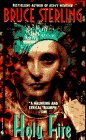
I walked into a barnes and nobles bookstore a few days ago and I was searching for a new book (even though I have a dozen at home that I haven’t read and another dozen on hold) when I found a book called Holy Fire by some other author, but it had the same cover as your book. Not the white one with the box and the face in it, but the face with the electronic stuff around it and the circle around the eye. I just wanted to let you know that there is another book out there that has stolen your book’s cover.

Alexander


No, really, it’s okay. Holy Fire is a novel by Bruce Sterling, a highly respected and accomplished writer, and was first published in 1997, long before Solitaire. The original artwork for the cover was created by a wonderful artist named Eric Dinyer. When it came time to create a new cover for the trade paperback of Solitaire, the publisher’s designer found this image and adjusted it for my cover. This happens a lot in publishing; it’s called recycling artwork, and it’s a way for the publisher to give a book a new “look” without the sometimes high cost of commissioning original art.

Bruce Sterling is aware that Solitaire used the same art as Holy Fire: he made a brief remark about it on this blog if you’re interested.

Ambivalence

14 July 2004 | Comments Off

I just finished reading Solitaire and am left with a few questions and conclusions.

I identified with Jackal in her search of “what am I and what am I suppose to do” in regards to being the “Hope”. I couldn’t figure out the big deal. But then, global and corporate domination isn’t something I would want to be associated with.

I saw her as a victim and a pawn, even at the end.

The elevator scenario was not her fault. She was doing her best, doing something when no one else was. And interestingly enough, I never thought she hit the wrong button, but instead the whole console was rigged by the terrorist. Nobody was going to get them out no matter what she or a technician did.

As I thought about the story, it dawned on me that the title of the book is ironic. Jackal was never by herself. Ever. Before prison it was Ko watching her, and during her sentence, the scientist/jailers were with her. Her implants kept her connected to the real world. No matter how much she thought she was alone or solo, she had to subconsciously understand that there were people always watching her. Interacting with her. Monitoring her every brain spike and functions. Her retreat to a unpopulated Ko showed she knew it would be the only way to be left by herself.

And now, she still isn’t alone. I never read where her implants and tracking devices were removed. She’s still not her own person. She’s still being controlled and observed, but just on her own terms.

Another puzzling part was her aversion to touch. Why would the lack of it for her imagined 8 years encourage her to pull away from it? It was mentioned at the end she recognized the last time someone had touched her, but yet, was uncomfortable with the one person whose touch she should have needed the most. Weird.

I enjoyed the “management “dialogs. It was interesting to see how things can be perceived with a corporate vision.

Thank you for a very thought provoking book.

Claudia


You’re welcome, although the book you read certainly wasn’t the book I meant to write. Not that it matters. I’ve been having an interesting discussion with a teacher about intentionality, and we agree that the writer’s intention isn’t the point of the reading experience. Still, I must say I’m sorry to hear that for you Jackal is a victim and a pawn throughout the book. I wouldn’t enjoy reading a book like that, and don’t much enjoy the thought that someone believes I’ve written one. But mileage varies, and it’s interesting to try to see the book from your point of view.

Very little of Solitaire is ironic, from my perspective (oh, here I go, talking about my intentions. Sorry. It’s hard not to, since I’m the writer as well as a reader in this case). Some long-term customers of the virtual pub may get a little tired of hearing me say this (oh well): I really do believe in hope, and small joys as well as great ones. I would wish the book to reflect that without irony.

Of course, Solitaire is also a novel that explores ambivalence on almost every level of the narrative, which is perhaps what has sparked some of your observations. It’s true for me that Jackal is still being observed, for example (her implants are there to stay), and controlled (she is still a convicted criminal with limited civil rights). And I also think she’s very much her own person, as much as any of us can be within the limitations that arise from living with other people in social structures.

There are so many folks in the world who never get to live on their own terms: it’s not an easy thing for me to categorize as “but just.” I think it’s a triumph: a small one perhaps, but a life of small triumphs is a successful life indeed.

The touch issue is another expression of the ambivalence that’s so much a part of the book. Not intentional (grin), but I can see how it fits into the larger pattern. Being literally untouched for an extended period of time can be a horribly isolating experience, especially if the body adjusts to it, and it becomes a physical norm. I think all humans have an individual baseline of touch (as we do with personal space, or tolerance of pain), and it’s my experience that if my baseline isn’t being met (because people are touching me too much, or not enough), I become uncomfortable. I think Jackal’s baseline changes pretty drastically in VC.

Touch is also part of the overall metaphor of connection in the book. Jackal identifies herself so strongly as connected (with Ko, the web, her family), and then she is so forcibly disconnected: her confusion about touch once she is out of VC is part of her overall confusion about reconnecting.

Hmm. That’s interesting to think about. Thanks for bringing it up.

I’m glad you enjoyed the management dialogs. I enjoyed writing them, and sometimes miss using my “business brain” on a daily basis as I did when I was in the corporate world. At the moment, I’m a member of a degree committee for a master’s candidate in organizational systems design, which is giving me the chance to share some of my knowledge and experience, and learn new things. Great fun. The corporate world isn’t the only arena where these skills are useful, but it’s one where having skill can make a huge difference to the quality of everyone’s daily experience. I’m biased, of course, but I wish more people cared enough about this stuff to instill it in their corporate cultures.

Cheers.